In this field note16 sections +Close −
- 01Four support models, not two
- 02What a guided expedition includes
- 03What a private expedition changes
- 04Base-camp service for independent climbers
- 05Leadership and decisions
- 06Safety differences
- 07Flexibility: real and imagined
- 08Cost comparison
- 09Staff welfare in every model
- 10Privacy, media and communication
- 11Who should choose a scheduled guided team?
- 12Who should choose a private expedition?
- 13Who should choose base-camp service?
- 14Operator interview checklist
- 15Internal planning links
- 16Frequently asked questions
“Guided” and “private” are often treated as opposite choices. In Karakoram operations they describe different dimensions. An expedition can be private but lightly supported, private and fully guided, or part of a shared departure with dedicated high-altitude staff. A base-camp-service climber may share food and communications while operating independently above camp.
The right model depends on competence, objective, desired control, group size and budget. The wrong model creates dangerous assumptions—especially when a climber believes “guided” means the mountain’s objective hazards have been transferred to someone else, or “private” means government, porter and rescue systems can be arranged informally.
From Skardu, every model still needs a licensed local operating structure for regulated objectives. Permits, staff, porter movement, transport, base camp, waste and emergency coordination do not disappear because the international team wants independence.
Contract principle: If a support task matters above base camp, it should appear in writing. The word “full service” is not a list of oxygen carries, high-camp tents or summit companions.
Four support models, not two
Model | Group structure | Operator role | Best suited to |
|---|---|---|---|
Scheduled guided team | Participants join fixed departure | End-to-end logistics and defined mountain leadership | Individuals wanting a team framework |
Private guided expedition | Dedicated departure for one party | Custom logistics and guide/staff allocation | Established group wanting privacy and control |
Base-camp service | Shared or private lower-mountain system | Permits, approach, base camp and agreed support | Independent experienced climbers |
Custom hybrid | Selected guided and independent components | Responsibility divided by stage | Teams with specific capabilities and gaps |
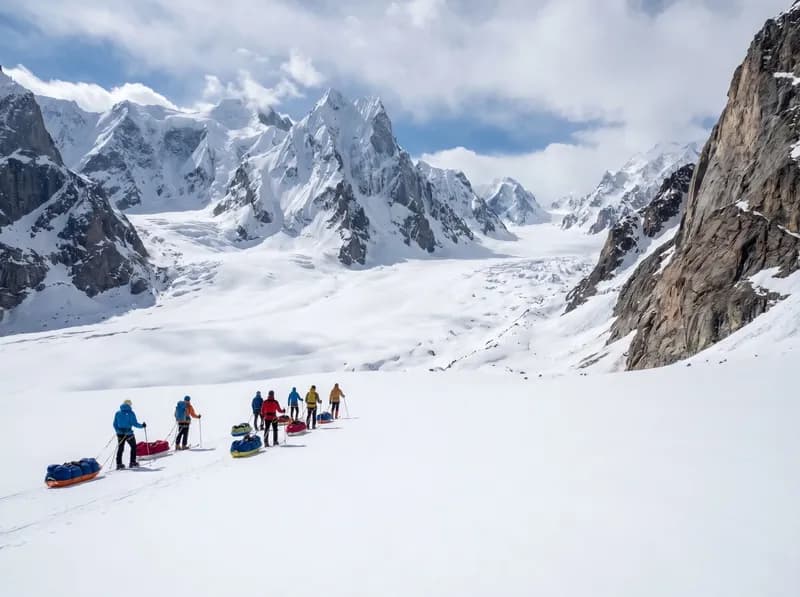
“Unguided” in Pakistan still usually involves an in-country operator for permits and logistics. “Private” describes who shares the departure, not necessarily how much technical help is included.
What a guided expedition includes
A guided programme should define an expedition leader or guide role, decision structure, participant screening and the technical scope of leadership. On a trek, the guide can control pace, route and camp decisions closely. On a large 8,000-metre mountain, climbers may be spread across camps and cannot be continuously supervised.
Potential inclusions are:
- Pre-departure résumé and equipment review
- Visa sponsorship and permit coordination
- Islamabad, Skardu and roadhead logistics
- Guide, cook, porter and liaison arrangements
- Base-camp accommodation, meals and communications
- Route briefings and weather information
- High-camp tents, fixed rope and oxygen as specified
- Dedicated or shared high-altitude staff
- Emergency communication and response coordination
The service does not make a summit safe or guaranteed. The participant remains responsible for fitness, honest medical disclosure, personal movement and obeying turnaround decisions.
What a private expedition changes
A private departure gives one team more influence over dates, pace, objective alternatives, menu, communications and staff allocation. It can protect group culture and privacy. For families, film crews, national teams or experienced partners, that control may be worth the cost.
Private does not mean unrestricted. Permit dates, road access, park rules, porter labour, weather and fixed-line coordination still constrain the plan. A team cannot demand that staff enter unsafe terrain simply because they are dedicated to the booking.
Small private teams also carry concentration risk. If one member becomes ill, the economics and technical capacity of the whole group can change. A shared expedition may have more staff and peers nearby, although responsibilities still must be clear.
Base-camp service for independent climbers
Base-camp service normally covers local administration, approach and a supported living system at base camp. Above that boundary, climbers may provide their own tents, rope, food, oxygen and route work, or purchase selected additions.
This model fits teams with proven high-altitude self-sufficiency. It does not fit a climber who needs someone else to choose equipment, manage oxygen and lead every fixed-line transition but wants the price of independent service.
Clarify these boundaries
- Where does staff support end?
- Who carries personal and group loads above base camp?
- Are high-camp tents supplied, erected or merely available?
- Is fixed rope included, and who participates in fixing?
- Are oxygen cylinders, masks, regulators and carries included?
- Who provides high-altitude food, fuel and stoves?
- What weather and radio information is shared?
- What happens if the climber needs assistance above the service boundary?
Leadership and decisions
Every team needs one clear operational chain. A private group may have its own climbing leader while Namla manages local logistics. A guided group may follow the expedition leader’s mountain decisions. A hybrid must define how disagreements are resolved.
At minimum, specify authority over:
- Route and camp movement
- Weather and summit timing
- Staff deployment
- Medical assessment and evacuation
- Turnaround decisions
- Communications with family and media
- Equipment caches and waste removal
Ambiguity becomes dangerous during an incident. A participant cannot assume the operator will launch a rescue without insurer authorisation, and a private leader cannot bypass local aviation and government channels.
Safety differences
A guided team can provide stronger screening, common procedures and immediate local judgement. A private team can be safer when its members have deep shared experience and communicate well. Neither label guarantees quality.
Safety depends on guide competence, ratios, staff equipment, participant honesty, medical systems, communications, conservative schedules and the willingness to change course. Ask for names and roles, not only a company history.
On technical climbs, ratio matters. One guide cannot remain beside several clients who move at very different speeds across multiple camps. Understand whether high-altitude staff are personal, shared or allocated according to conditions.
Flexibility: real and imagined
Private expeditions can adjust daily plans more easily because there are fewer customer expectations to balance. They can add acclimatisation, change a side objective or use a different communication schedule.
However, mountain flexibility is bounded by resources. Extra days require food, fuel, wages and porter arrangements. Changing to another regulated peak may require another permit and fee. Shifting the entire arrival date affects hotels, vehicles and staff who may have other seasonal commitments.
The most useful flexibility is pre-planned: named alternatives, a contingency budget and a process for changes.
Cost comparison
Scheduled teams spread vehicle, permit administration, base-camp, cook, communication and staff costs across participants. Private teams pay those fixed costs among fewer people and may add dedicated guides or vehicles. That makes private service more expensive per person, especially for one or two climbers.
Base-camp service can cost less because high-altitude support is excluded. It becomes expensive if the climber later buys oxygen carries, tents and staff at short notice. Compare the total likely requirement, not the minimum entry price.
Cost items to compare line by line
- Permit, royalty, environment and liaison fees
- Hotels, domestic transport and road contingencies
- Porter stages, baggage limits and extra loads
- Base-camp tents, food, fuel, shower and charging
- Guide and high-altitude staff ratios
- Oxygen system and carries
- Fixed rope and shared route equipment
- Weather, satellite and medical services
- Staff insurance and rescue arrangements
- Extra-day and early-return terms
Staff welfare in every model
Private clients sometimes assume dedicated staff are available for any task. Staff roles remain limited by skill, equipment, insurance, weather and safe working conditions. A trekking porter should not be sent onto technical terrain because the team packed too much.
Responsible service includes agreed wages, load control, food, shelter, clothing, insurance, medical care and safe return for illness or injury. Tips remain separate from wages. The contract should also address high-altitude bonuses and summit work where applicable.
Privacy, media and communication
A private expedition offers more control over photographs, sponsorship and daily reports. Establish who can publish images of team members and local staff. Consent matters in Askole, base camp and on the mountain.
If families receive scheduled updates, explain that a missed message can result from battery, signal or workload rather than emergency. During an incident, one nominated contact should communicate verified information. Multiple relatives calling different staff can obstruct operations.
Film crews need separate planning for permits, drones, power, data, porters and image consent. A camera kit is expedition cargo and counts toward transport.
Who should choose a scheduled guided team?
Choose it if you are joining alone, value a set structure, want peer support and need defined mountain leadership. It is often efficient for first experience on a particular Karakoram trek or appropriately progressive climbing objective.
Screen the departure: group size, guide ratio, language, expected pace and minimum experience should all be clear.
Who should choose a private expedition?
Choose private if your group already knows each other, requires specific dates or goals, needs privacy, or wants dedicated staff and communication. It is also useful for families, clubs, research teams and specialist film or ski projects.
Be ready to pay the true fixed cost and take part in detailed planning.
Who should choose base-camp service?
Choose it only if the climbing team can operate independently above base camp, including route, camps, technical rescue, high-altitude food, oxygen where used and retreat. The service should complement capability, not conceal its absence.
Operator interview checklist
- Is the company licensed for the activity and current season?
- Who is the expedition leader and what is their role?
- What guide or high-altitude staff ratio applies?
- Which equipment and carries are included above base camp?
- How are staff insured, equipped and paid?
- What participant screening is required?
- Who makes weather, medical and turnaround decisions?
- What are the cancellation, extra-day and early-return terms?
- How are rescue authorisation and family communication handled?
- Which waste and camp-clearance standards apply?
Internal planning links
Support models can be tailored for the K2 Expedition, Broad Peak Expedition and Snow Lake Ski Expedition. Compare K2 vs Broad Peak, trekking versus mountaineering and Pakistan visa and invitation requirements.
Frequently asked questions
Is a private expedition always guided?
No. Private describes an exclusive departure. It can be fully guided, base-camp-only or a custom hybrid. The service level must be specified separately.
What is base-camp service?
It normally includes local administration, approach logistics and accommodation, food and operations at base camp. Support above base camp varies and should never be assumed.
Is a guided expedition safer?
Good guiding can improve screening, decisions and response, but no guide removes objective hazard. Quality, ratios, systems and participant behaviour matter more than the label.
Why does a private expedition cost more?
Vehicles, permits, base camp, cooks, communication and management are fixed costs shared by fewer people. Dedicated guides and customised logistics add further cost.
Can a private team change peaks after arrival?
Not freely. Another regulated peak may require a separate permit, fee, equipment, staff and schedule. Alternatives should be discussed before applications begin.
Do independent climbers still need a local operator?
For regulated Karakoram objectives, foreign teams normally work through a licensed Pakistani operator for permits and local logistics even when climbing independently above base camp.
End of field note
Continue your research.
Browse all notes