In this field note15 sections +Close −
- 01The activities overlap
- 02Ski touring skill is more than downhill ability
- 03What mountaineering adds
- 04Avalanche hazard applies to both
- 05Glacier travel on skis
- 06Equipment comparison
- 07Boots and skis: the key compromise
- 08Fitness demands
- 09Route planning and turnaround
- 10Guides, partners and ratios
- 11Insurance and rescue
- 12A progression from tourer to ski mountaineer
- 13Readiness checklist
- 14Internal planning links
- 15Frequently asked questions
Ski touring uses skins and human power to travel uphill before descending on skis. Mountaineering uses climbing systems to move through snow, ice, rock and glaciated terrain. Ski mountaineering combines the two, but there is no universal line where a tour changes category.
A low-angle day from a village can still enter avalanche terrain. A broad glacier tour can require ropes because crevasses are hidden. A high ski descent may require boot crampons, an ice axe and anchors even if the skiing itself is moderate. The route—not the label on the booking—determines the skills.
In Gilgit-Baltistan, remoteness raises the consequence of both activities. A minor binding failure or injured knee can occur several days from road access. Participants need more expedition self-sufficiency than they would near a lift or staffed hut.
Guide’s definition: If a team must climb, rope, protect or make a technical retreat to complete the intended route, we plan it as ski mountaineering even when most distance is travelled on skis.
The activities overlap
Factor | Ski touring | Ski mountaineering | Mountaineering without skis |
|---|---|---|---|
Uphill tool | Skins on skis | Skins, boot crampons and climbing | Boots, crampons and climbing systems |
Descent | Primarily skiing | Skiing plus rappels, down-climbing or carrying | Walking, down-climbing or rappelling |
Typical terrain | Snow slopes and tours | Glaciers, couloirs, ridges and peaks | Snow, ice, rock and mixed routes |
Rope use | Sometimes on glaciers | Common on technical or glaciated routes | Route-dependent and often central |
Essential risk skill | Avalanche rescue and terrain choice | Avalanche, glacier, rope and climbing rescue | Climbing, glacier and objective-hazard systems |
Main equipment | Touring ski system, transceiver kit | Ski kit plus harness, axe, crampons, rope hardware | Mountaineering kit without ski system |
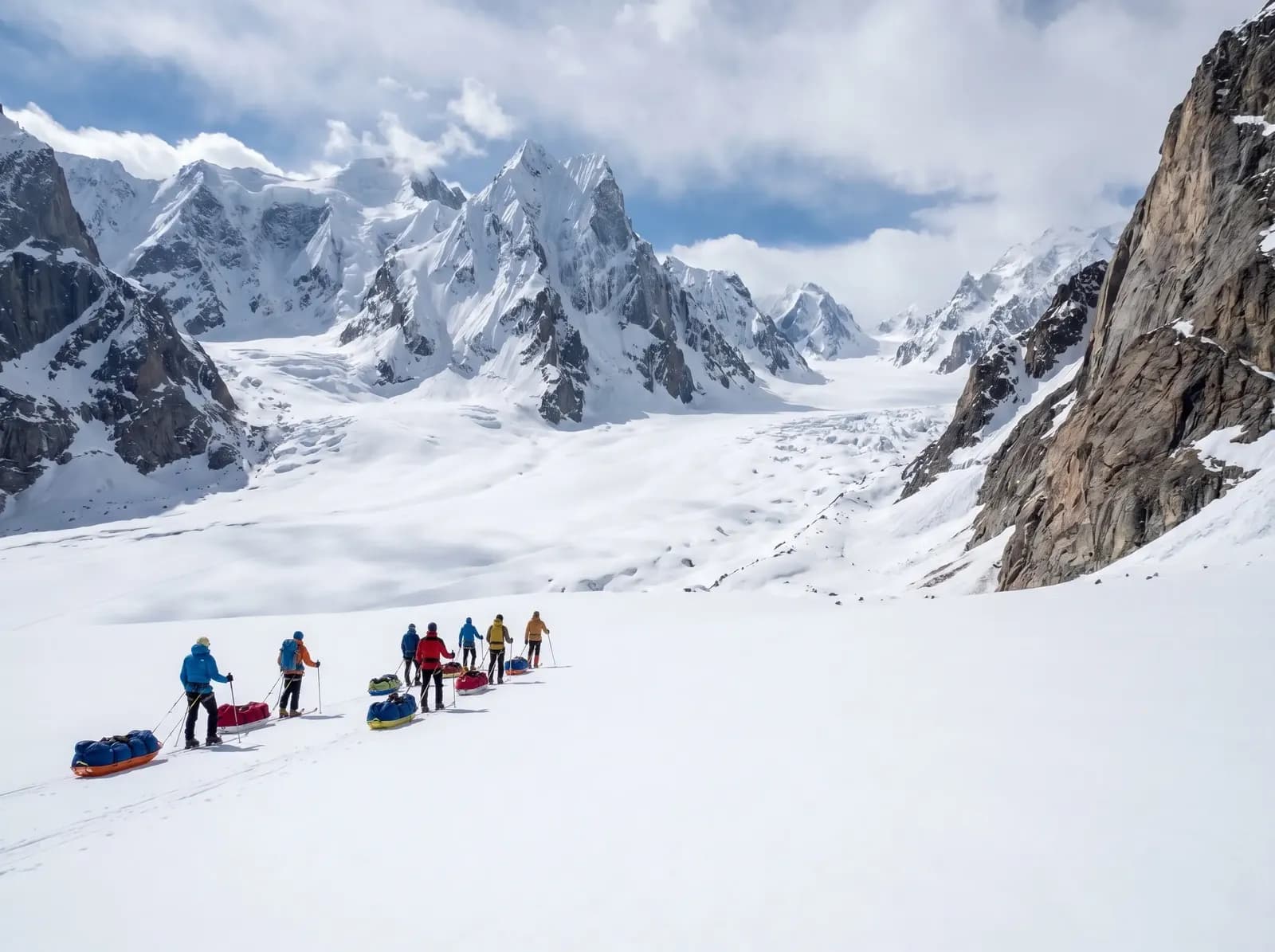
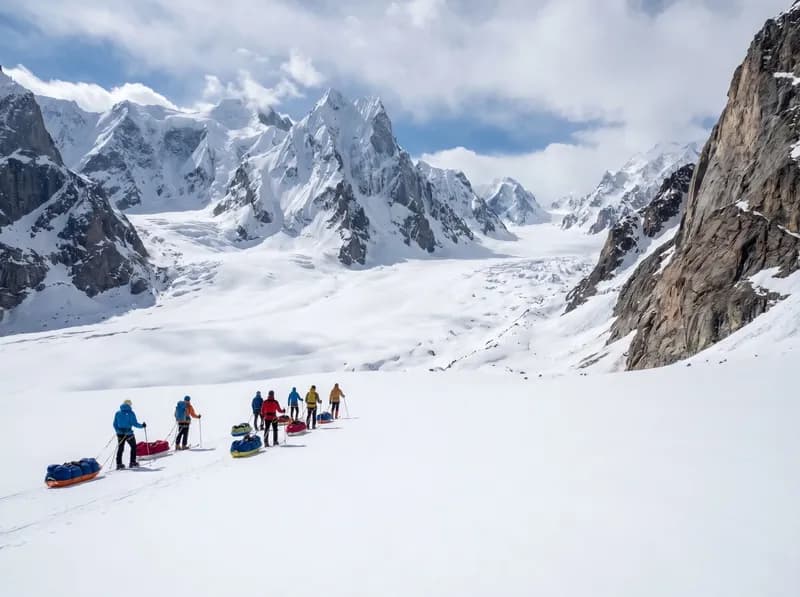
The same itinerary may include all three modes. On Snow Lake, skis can be carried on lower moraine, used for efficient upper-glacier movement and removed for a technical section.
Ski touring skill is more than downhill ability
A strong resort skier may be unprepared for touring. Uphill movement requires skin technique, kick turns, pacing, transitions and equipment management. Descents are not groomed or controlled and may include crust, wind slab, deep snow, hard refreeze and narrow route-finding.
An expedition tourer should be able to:
- Skin efficiently for several hours
- Perform kick turns on firm, exposed slopes
- Transition without dropping equipment or delaying the group
- Use ski crampons before the slope becomes unmanageable
- Ski variable snow with a pack and controlled speed
- Repair skins, poles and simple binding faults
- Travel on consecutive days without losing technique
Fast skiing is not the goal. Control and predictable movement keep the group spaced and reduce exposure.
What mountaineering adds
Mountaineering adds a different decision set. The team may rope for glaciers, front-point with crampons, build anchors, rappel, belay or carry skis on a pack while climbing. Equipment becomes more complex and transitions occur in exposed places.
Technical competence must include descent. Reaching a col by climbing does not solve how the team returns if snow becomes unskiable. Practise rappelling with skis, lowering packs, moving along fixed ropes and protecting a tired partner before the expedition.
Ski mountaineers also manage sharp equipment around inflatable mats, ropes, clothing and tents. Good camp organisation is a safety skill.
Avalanche hazard applies to both
Ski touring and ski mountaineering enter avalanche terrain. Steeper objectives add exposure but low-angle travel can still pass beneath release zones. Every participant needs a transceiver, shovel and probe and current companion-rescue practice.
Many Karakoram areas do not have a comprehensive daily public avalanche bulletin. Teams build a field assessment from snowfall, wind, temperature, snowpack observations and recent activity. Uncertainty should lead to conservative terrain, not confident language.
Daily avalanche routine
- Review weather and overnight change.
- Define the avalanche problem and terrain consequence.
- Complete a transceiver function check.
- Observe cracking, drifting, recent slides and warming.
- Space the team and expose one person at a time where appropriate.
- Reassess at aspect and elevation changes.
- Choose a descent suitable for the least-confident member.
A transceiver can help after burial. It does not make a slope safe to enter.
Glacier travel on skis
Skis distribute weight and move efficiently across covered glacier, but they do not guarantee that a snow bridge will hold. Roped ski travel requires appropriate spacing, coils, communication and rescue readiness. Kick turns and descents must avoid slack tangles.
Flat light can hide depressions and crevasse clues. Navigation uses map, compass, GPS and visual knowledge; one phone is not a system. Cold batteries and whiteout make redundancy essential.
Every team member should understand the hauling plan and carry assigned hardware. A guide may lead route selection, but companions form the immediate rescue team.
Equipment comparison
Touring system
- Touring skis, bindings and skins
- Compatible ski crampons
- Touring boots with reliable walk mode
- Adjustable poles with larger baskets
- Transceiver, metal shovel and probe
- Helmet according to terrain
- Repair kit and spare skin attachments
Mountaineering additions
- Harness that works with ski clothing
- Boot crampons compatible with the same boots
- Ice axe suited to objective
- Rope and glacier-rescue hardware
- Locking carabiners, prusiks and slings
- Technical tools or protection where required
- Bivy and emergency shelter appropriate to commitment
Compatibility should be tested as one system. A crampon that fits a boot in the living room may release when the sole flexes or collects snow.
Boots and skis: the key compromise
Light boots tour efficiently but may provide less warmth, durability or climbing support. Heavy boots climb and ski powerfully but increase fatigue over long approaches. Ski width affects flotation, edge control, weight and pack carrying.
For remote Karakoram use, reliability and repairability often outweigh marginal weight savings. Bring binding-specific parts, spare screws, straps, wire and a tool that actually fits each fastener. Personally fitted boots should come from home; do not depend on finding a replacement size in Skardu.
Fitness demands
Ski touring is a long aerobic activity with repeated leg work. Ski mountaineering adds heavier equipment, upper-body rope work, crampon climbing and longer transitions. Altitude reduces pace and recovery.
Training should include:
- Easy aerobic volume across several months
- Uphill sessions with increasing vertical gain
- Leg and trunk strength twice weekly
- Balance and eccentric control for difficult descents
- Pack carries with skis attached
- Consecutive tours or hikes
- Technical practice while wearing gloves
The last hard training block should finish early enough for recovery before travel. Arriving fatigued weakens acclimatisation and increases injury risk.
Route planning and turnaround
A touring day can often reverse on the uptrack. A technical ski mountaineering objective may cross a col, descend a different glacier or rappel terrain that cannot be reclimbed easily. Decision points must account for the whole route.
Before starting, define:
- Latest time to enter the technical section
- Minimum visibility and snow criteria
- Whether the descent can be inspected
- Escape routes before and after commitment
- Rope and anchor plan for unskiable terrain
- Minimum food, fuel and battery reserve
- Communication schedule and missed-check-in action
Summit or line quality must remain secondary to a safe exit.
Guides, partners and ratios
On a moderate tour, a guide may lead a small group through terrain and snow decisions. On technical ground, the number of clients one guide can protect falls. Ask how the ratio changes for glacier, rappel or steep climbing sections.
Partners need compatible pace and risk tolerance. A fast expert who disappears ahead is not useful in companion rescue. Practise transceiver and rope systems together before departure.
Insurance and rescue
Policies may distinguish off-piste skiing, backcountry touring, ski mountaineering, ropes and slope angle. Describe the actual route and equipment and obtain written confirmation for Pakistan and the maximum altitude.
Helicopter rescue is never guaranteed. Weather, landing terrain, altitude, aircraft availability, daylight and authorisation all matter. A technical team needs self-rescue, emergency shelter and the ability to assist an injured skier toward a workable evacuation point.
A progression from tourer to ski mountaineer
- Become a controlled off-piste skier in variable snow.
- Learn efficient skinning, kick turns and transitions.
- Complete avalanche education and repeated companion-rescue practice.
- Tour with experienced leadership in different snowpacks.
- Learn crampon, axe, rope and anchor systems.
- Practise glacier travel and crevasse rescue on skis.
- Complete shorter ski mountaineering routes with simple retreat.
- Build to multi-day glacial and expedition objectives.
Progress by responsibility, not by steepness alone. A moderate remote traverse may demand more complete judgement than a steep line near a road.
Readiness checklist
- I can ski crust, hard snow and heavy snow with a pack.
- My transitions are efficient in wind and gloves.
- Companion rescue is current, not remembered from years ago.
- I can use crampons and an axe on ascent and descent.
- I have practised roped glacier travel and crevasse rescue.
- My equipment works as a complete compatible system.
- I can accept a low-angle alternative or no-ski day.
- Insurance covers the exact activity and altitude.
Internal planning links
See how these skills apply on the Snow Lake Ski Expedition, or compare progression on Spantik and Laila Peak. Continue with ski expeditions in Gilgit-Baltistan, best ski timing and expedition fitness.
Frequently asked questions
Is ski touring the same as ski mountaineering?
They overlap. Ski mountaineering includes climbing, glacier or technical terrain that requires rope, crampon, axe, anchor or retreat skills beyond ordinary touring.
Do ski tourers need avalanche training?
Yes. Touring commonly enters avalanche terrain. Every participant should understand terrain choice and be competent with transceiver, shovel and probe.
Can a strong resort skier join Snow Lake?
Not on resort ability alone. The skier needs efficient uphill touring, variable-snow control, expedition fitness, avalanche skills and glacier competence.
Are skis safer than walking on a glacier?
Skis spread load but do not guarantee snow-bridge strength. Roping, spacing, route finding and rescue readiness remain necessary.
Do I need two pairs of boots?
Usually one compatible touring and mountaineering system is preferred, but objective and camp footwear needs vary. Confirm boot, binding and crampon compatibility with the operator.
Is ski mountaineering covered by normal travel insurance?
Often not. Policies may exclude off-piste skiing, ropes, glaciers, slope angles or high altitude. Obtain written route-specific confirmation.
End of field note
Continue your research.
Browse all notes