In this field note16 sections +Close −
- 01Why one grade is not enough
- 02Our five-level framework
- 03Factor 1: daily physical load
- 04Factor 2: terrain
- 05Factor 3: altitude
- 06Factor 4: technical exposure
- 07Factor 5: remoteness and support
- 08Route examples
- 09How to assess yourself honestly
- 10Training by grade
- 11Accommodation affects difficulty
- 12Weather and season
- 13Insurance and evacuation
- 14Booking checklist
- 15Internal planning links
- 16Frequently asked questions
A single word such as moderate, difficult or extreme is not enough to describe a Karakoram trek. K2 Base Camp has no technical summit climbing, yet many strong day hikers find its repeated moraine, camping and remoteness harder than a steeper trail near home. Gondogoro La adds fixed ropes and crampons. Snow Lake adds quieter crevassed glacier travel and a committing pass.
Namla evaluates trekking difficulty across five factors: daily physical load, terrain, altitude, technical exposure and remoteness. The overall grade follows the route’s most consequential sustained demands, not an average that hides one serious day.
This system is a planning tool, not a guarantee. Weather, illness, road changes and individual response can make the same itinerary feel different between teams.
Guide’s warning: Do not choose a trek because you can run a fast 10 kilometres. Uphill endurance helps, but foot durability, balance, recovery, altitude response and comfort in a tent decide many Karakoram outcomes.
Why one grade is not enough
Factor | What we assess | Common mistake |
|---|---|---|
Physical load | Hours, ascent, descent and consecutive days | Looking only at the longest day |
Terrain | Trail, moraine, boulders, glacier, river and snow | Assuming low gradient means easy walking |
Altitude | Sleeping profile, maximum height and recovery | Believing fitness prevents altitude illness |
Technical exposure | Crampons, fixed ropes, steep snow and consequence | Treating supplied equipment as supplied skill |
Remoteness | Distance from road, communication and evacuation | Assuming a helicopter is always available |
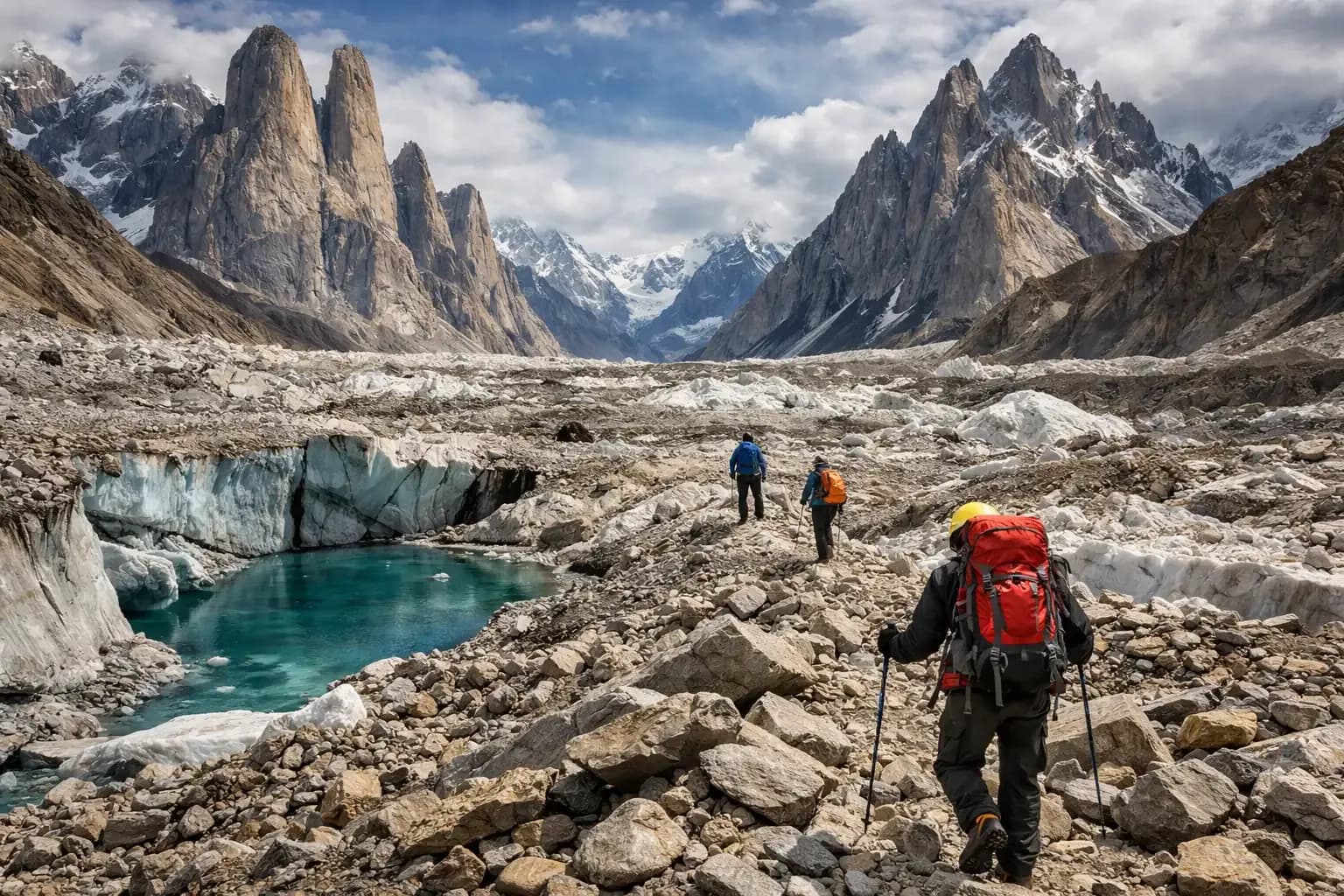
A lodge-based trail and a tented glacier trek with similar distance should not share a grade. Recovery conditions change difficulty.
Our five-level framework
Level 1: Easy walking
Short day walks on established paths at low or moderate elevation, with vehicle or accommodation access. A normally active person can participate with basic preparation.
Level 2: Moderate trekking
Several walking days, some ascent and uneven trail, but limited technical exposure. Accommodation may be lodge or camp. Participants should train regularly and be comfortable walking four to six hours.
Level 3: Strenuous trekking
Longer consecutive days, rough ground, camping and meaningful altitude. Recovery, foot care and pacing become central. K2 Base Camp sits within this broad category for many operators, though individual itineraries vary.
Level 4: Very strenuous / technical trekking
Sustained remote travel plus crampons, glacier systems, fixed ropes, steep pass movement or unusually long days. Gondogoro La and the full Snow Lake–Hispar traverse fit here when technical conditions are present.
Level 5: Expedition-level trekking
Exceptional remoteness, complex glacier or pass travel, limited retreat and multiple high-consequence days. This grade approaches mountaineering and requires route-specific technical and expedition experience.
These levels do not replace the factor scores below. They summarise them for comparison.
Factor 1: daily physical load
Distance alone is misleading on moraine. Ten kilometres across loose glacier debris can take longer and demand more concentration than a much longer maintained trail. We consider hours, elevation change, pack, footing and how many days repeat.
Questions to ask
- What is the longest scheduled day in hours, not only kilometres?
- How many consecutive days exceed six hours?
- What day follows the main objective?
- Is there a rest day, and at what altitude?
- How much personal weight is carried?
- Are exit stages easier, or must the team repeat the approach?
A successful summit or base-camp day is not the end. The trekker must still return safely.
Factor 2: terrain
Karakoram terrain includes dry trail, sand, river edges, loose scree, boulders, debris-covered ice, meltwater channels and snow. The Baltoro undulates constantly. Snow Lake can move from rough lower glacier to covered crevasses. Autumn snow can hide rocks that were visible in summer.
Balance, ankle strength and careful foot placement matter. Walking poles help but cannot compensate for unsuitable boots or racing. Training should include rough trails, not only treadmills.
Terrain also changes after floods and glacier movement. A published GPS track is historical evidence, not an instruction to ignore the guide’s current line.
Factor 3: altitude
K2 Base Camp, Snow Lake, Concordia and major passes lie high enough for acute mountain sickness. The risk depends primarily on ascent profile and individual susceptibility, not athletic ability. A person who runs marathons can become ill while a slower companion acclimatises well.
The CDC high-altitude guidance recommends gradual sleeping-height gains and says travellers should not ascend with symptoms and should descend if symptoms worsen.
Evaluate:
- Altitude of the first sleeping night after flight or road travel
- Daily change in sleeping height above 3,000 metres
- Rest or acclimatisation days
- Highest sleeping camp versus highest day point
- Ease of descent from high camps
- Whether a pass forces ascent before descent
An itinerary with more days is not automatically better if those days add poor or unnecessary movement. Look at the profile.
Factor 4: technical exposure
Standard K2 Base Camp trekking mainly requires balance and endurance. Gondogoro La can require crampons, harness, helmet, axe and fixed ropes. Snow Lake may require roped glacier travel. These skills change the route category.
Equipment reduces risk only when correctly used. Participants should practise before departure and repeat systems at a safe camp. Technical exposure also includes rockfall, avalanche paths and steep traverses where a slip has greater consequence.
Ask who provides equipment, whether boots are compatible, what training is required and what happens if the technical section is unsafe.
Factor 5: remoteness and support
After Askole, there is no road along the Baltoro or Biafo. A casualty may need porter assistance, stretcher movement, several days of descent or a weather-dependent helicopter. Communication uses expedition radios or satellite systems rather than reliable mobile service.
Remoteness increases the consequence of ordinary issues:
- Blisters can alter pace for days.
- Diarrhoea can cause dehydration and weakness.
- A broken boot can end the journey.
- A lost waterproof layer can become a cold injury risk.
- A delayed insurance authorisation can postpone evacuation.
Good support includes trained guides, medical kit, communication, staff welfare, contingency food and a ground response plan.
Route examples
Journey | Physical | Terrain | Altitude | Technical | Remoteness | Overall guide |
|---|---|---|---|---|---|---|
Settled-valley day hikes | 1–2 | 1–2 | 1–2 | 1 | 1–2 | Easy to moderate |
K2 Base Camp standard return | 4 | 4 | 4 | 2 | 5 | Strenuous |
K2 Base Camp with Gondogoro La | 5 | 5 | 5 | 4–5 | 5 | Very strenuous / technical |
Biafo Glacier trek | 4 | 4–5 | 4 | 3–4 | 5 | Strenuous to very strenuous |
Snow Lake–Hispar La traverse | 5 | 5 | 5 | 4 | 5 | Very strenuous / expedition level |
These are comparative, not medical or legal ratings. Conditions and itinerary design can move a factor up or down.
How to assess yourself honestly
Recent comparable experience is the best starting point. A trek completed ten years ago says less than last season’s long, wet, multi-day route. Describe what you carried, terrain, sleeping conditions, altitude and how you felt on the final days.
Useful readiness evidence
- Back-to-back six- to eight-hour hikes with a daypack
- Comfort on loose rock and boulders
- Multiple nights in a tent below freezing
- Previous response above 3,500–4,000 metres
- Ability to eat, hydrate and organise while tired
- Technical course and recent practice if required
- Calm response to itinerary changes and exposure
Do not hide a knee problem or altitude history to secure a booking. Accurate information lets the operator recommend training or another route.
Training by grade
Levels 1–2
Walk three to four times weekly, build general strength and test footwear. Include moderate hills and one longer weekly outing.
Level 3
Build a three- to six-month aerobic base, strength train twice weekly and complete regular long hikes. Add back-to-back days and rough terrain in the final two months.
Level 4
Use the Level 3 base plus route-specific crampon, rope or glacier training. Complete consecutive long days with early starts and a realistic pack.
Level 5
Arrive with extensive previous expedition and technical experience. Training supports that background; it cannot manufacture it in one season.
Accommodation affects difficulty
Tented trekking reduces recovery compared with comfortable lodging. Sleep may be interrupted by cold, wind or altitude. Washing and drying are limited. Food choice narrows farther from the road.
This does not make camping bad; it makes camp skill important. A person who packs efficiently, changes damp layers and sleeps well will recover better than someone expending energy on disorganisation.
Weather and season
Lower approaches can be hot, upper camps cold and storms possible within one itinerary. Autumn makes nights colder and days shorter. Spring glacier routes can involve stronger solar change and snow bridges. Difficulty grades assume a normal operating window, not worst-case weather.
The guide may shorten a day, wait, change a camp or turn around. Flexibility is a safety feature, not evidence that the published grade was wrong.
Insurance and evacuation
Insurance must cover Pakistan, the itinerary’s maximum height and all technical activities. A policy limited to hiking on marked trails may not cover glacier ropes or Gondogoro La.
Helicopter rescue is never guaranteed. The team still needs ground movement, first aid and communication. People with serious health concerns should consult a travel-medicine clinician and share relevant information with the operator.
Booking checklist
- I have read the day-by-day hours and terrain, not only the overall grade.
- My recent experience matches at least the physical and terrain factors.
- I have disclosed health, injury and altitude history.
- Technical training is complete for pass or glacier systems.
- My boots and sleep system are tested.
- Insurance covers the route, altitude and equipment use.
- I accept that weather can change the itinerary.
- I have post-trek contingency before my international flight.
Internal planning links
Compare the standard K2 Base Camp Trek, K2 Base Camp with Gondogoro La and Snow Lake and Hispar La. Prepare with how difficult K2 Base Camp is, expedition fitness and trekking vs mountaineering.
Frequently asked questions
How difficult is K2 Base Camp?
It is a strenuous remote trek because of consecutive days, rough moraine, altitude, camping and distance from road access. It does not normally require summit-climbing technique.
Is Gondogoro La harder than K2 Base Camp?
Yes. It adds steep snow, fixed ropes, crampons, exposure and an early technical pass crossing to the already demanding trek.
Does a difficult grade mean I will get altitude sickness?
No. Fitness and grade do not predict individual susceptibility. Ascent profile, previous response and current symptoms guide altitude decisions.
How many months should I train?
Most strenuous-trek participants benefit from three to six months of consistent preparation. Technical or expedition-level routes require prior experience that cannot be created by short-term fitness training.
Are walking poles required?
They are strongly useful on moraine, descents and river edges. Practise with them so they improve balance rather than interfere with foot placement.
Can a beginner trek K2 Base Camp?
A very fit and well-prepared person with strong multi-day hiking and camping experience may succeed, but it is not a suitable first hike. Build experience and obtain an honest operator assessment.
End of field note
Continue your research.
Browse all notes