In this field note8 sections +Close −
- 01Why ordinary travel insurance is often inadequate
- 02Questions to ask before buying a policy
- 03Insurance, rescue assistance and evacuation membership
- 04How a helicopter rescue is initiated
- 05The ground plan still matters
- 06What participants should carry
- 07Our practical recommendation
- 08Frequently asked questions
Travel insurance for the Karakoram is not a formality. It is part of the expedition’s emergency system. A policy must cover the actual country, route, altitude and activity, and it must be capable of responding when a casualty is several days from the nearest road.
From Skardu, our operations team checks insurance information before a group leaves for Askole. We do this because the words “adventure travel” or “medical evacuation” on a certificate do not automatically mean that K2 Base Camp, Gondogoro La or a climbing expedition is covered.
A helicopter is never guaranteed. Insurance can arrange and pay for an eligible rescue, but it cannot make an aircraft fly through cloud, strong wind or darkness.
Why ordinary travel insurance is often inadequate
Many standard policies have altitude limits, exclude mountaineering, or distinguish between walking and the use of ropes, crampons and fixed lines. Some cover medical evacuation but not search and rescue. Others reimburse expenses only after the traveller has paid them. That difference matters when a provider requires financial authorisation before an aircraft is requested.
K2 Base Camp is commonly listed at approximately 5,150 metres. A Gondogoro La itinerary goes higher and can involve fixed-rope travel. A climbing expedition may operate far above both. The policy must match the highest planned point and the most technical planned activity, not simply the average trekking altitude.
Questions to ask before buying a policy
- Is Pakistan covered for the complete trip, including the Baltoro and the named route?
- What is the maximum covered altitude, and is that limit stated in writing?
- Are trekking, mountaineering, fixed ropes, crampons and the intended peak covered where applicable?
- Are search, helicopter rescue, medical evacuation and repatriation separate benefits?
- Can the assistance centre issue a direct guarantee of payment?
- Does current government travel advice affect the policy?
- Are pre-existing medical conditions accepted and recorded?
- Is there a 24-hour emergency number that works from Pakistan?
- Who must authorise treatment or evacuation before costs are incurred?
Ask the insurer to identify the relevant clauses. A sales email saying “you should be fine” is not enough. Keep the complete wording offline and send Namla Expeditions the policy number, assistance contact, insurer name and maximum covered altitude before arrival.
Insurance, rescue assistance and evacuation membership
These products can overlap, but they do not always perform the same job. An insurer may pay eligible medical costs. An assistance company may coordinate the response. A rescue membership may arrange evacuation under its own conditions. If two organisations are involved, establish which one must be contacted first and which one supplies the payment guarantee.
Also confirm the destination of evacuation. A helicopter flight to Skardu is not the end of the case. The casualty may need a hospital assessment, a scheduled flight to Islamabad, an air ambulance or repatriation. Each stage can fall under a different section of the policy.
How a helicopter rescue is initiated
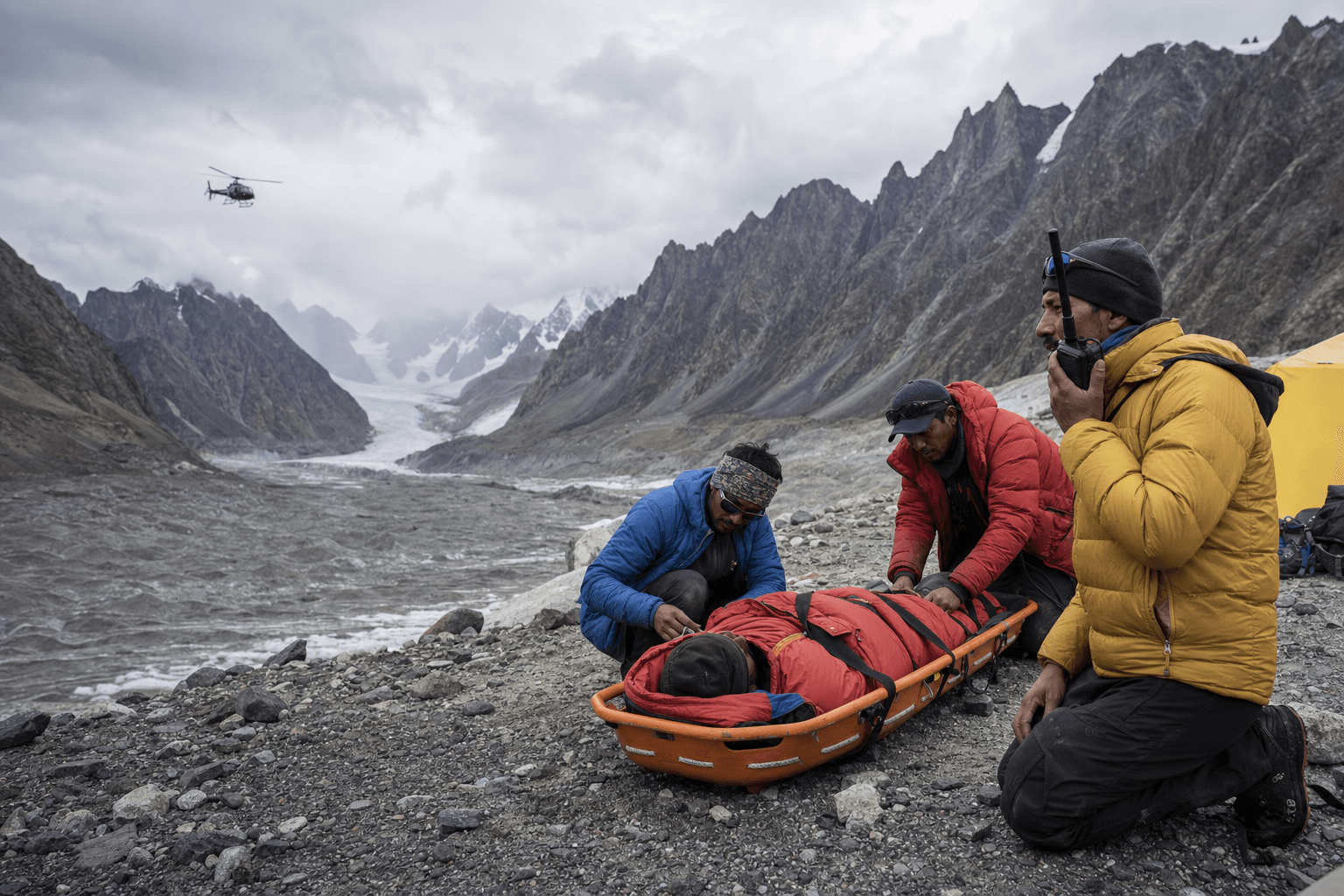
When an incident occurs, the guide first assesses the casualty, provides immediate care and identifies the safest available options. The field team reports the patient’s condition, location, altitude and urgency to the Skardu operations base. We then work through the agreed emergency contacts, insurer or assistance provider and the relevant aviation or government channels.
The aviation provider considers the weather along the entire flight path, not only at the casualty’s camp. It also considers daylight, altitude, aircraft performance, landing terrain, crew availability and other operational priorities. If a flight is approved, the field team may need to prepare or mark a landing area and control people and loose equipment nearby.
Why rescue may be delayed
- Low cloud or poor visibility between Skardu and the glacier
- Strong wind, snowfall or rapidly changing mountain weather
- Darkness or insufficient safe flying time
- Aircraft or crew availability
- An unsafe landing site or a casualty above practical landing altitude
- Communication problems or slow financial authorisation
A clear sky above Concordia does not prove that the valleys toward Skardu are open. Equally, a helicopter seen elsewhere in the region is not automatically available for a private evacuation.
The ground plan still matters
Every remote team needs an alternative to immediate flight. Depending on the incident, that may mean stabilising the patient in camp, assisted descent, stretcher movement, additional porter support, relocation to a safer landing point or transfer to a jeep below Askole.
This is why early reporting is critical. A participant who hides worsening headache, poor coordination, breathlessness at rest, confusion or persistent vomiting may lose the opportunity for a controlled descent. Reporting symptoms does not automatically end the trip; it gives the guide time to make a measured decision.
What participants should carry
- Insurance certificate and full policy wording stored offline
- Policy number and 24-hour assistance telephone number on paper
- Personal medication in the daypack, not the porter duffel
- A concise medical summary and allergy information
- Emergency contact details
- Passport and visa copies
Our practical recommendation
Buy cover as soon as cancellation exposure begins, but do not choose only by price. Confirm the exact route, maximum altitude, activities, rescue benefit, direct-payment procedure and effect of travel advisories. Send the documents early enough for questions to be resolved before reaching Skardu.
No insurance policy removes mountain risk. A suitable policy, an experienced field team, honest symptom reporting and a realistic ground evacuation plan create the strongest available response when conditions become difficult.
Frequently asked questions
Is helicopter rescue included in every travel policy?
No. Some policies exclude search and rescue, impose altitude limits or cover medical transport only after the patient reaches a road or hospital.
Is a helicopter evacuation guaranteed after authorisation?
No. Weather, daylight, aircraft availability, altitude and landing conditions still control whether a flight is possible.
What altitude should K2 Base Camp insurance cover?
The policy should cover at least the itinerary’s stated maximum altitude. K2 Base Camp is commonly described at approximately 5,150 metres.
Can Namla Expeditions buy my personal insurance?
Participants normally purchase their own policy because eligibility, residence, medical history and consumer protections depend on the traveller. We can check whether the certificate states the operational information we require.
End of field note
Continue your research.
Browse all notes