In this field note13 sections +Close −
- 01The essential difference: visa, invitation letter and permit
- 02Pakistan visas for trekkers and climbers
- 03What is a letter of invitation?
- 04Trekking and mountaineering permits in Gilgit-Baltistan
- 05Travel insurance for a Karakoram expedition
- 06How helicopter rescue works in the Karakoram
- 07Life on the Baltoro Glacier
- 08K2 Base Camp versus Everest Base Camp
- 09Porter loads and expedition logistics
- 10Porter welfare is part of expedition safety
- 11Pre-departure checklist
- 12Final advice from our operations team
- 13Frequently asked questions
A journey to K2 Base Camp begins long before the road to Askole. The important work happens during the months before arrival: selecting the correct visa category, processing permits, checking rescue cover, planning personal equipment and understanding how a supported expedition operates.
These details are connected. A visa application may require documents from a licensed operator. A permit depends on accurate passport information. Porter loads influence the number of staff and animals required. An insurance policy is useful only if it covers the actual altitude, activity and rescue conditions of the route.
Information review: Visa procedures, permit requirements, government fees and aviation arrangements can change between seasons. This guidance was reviewed in July 2026. Always confirm current requirements before applying or paying.
The essential difference: visa, invitation letter and permit
A Pakistan visa allows entry for the approved purpose and period. A letter of invitation or sponsor letter supports the application and identifies the local operator. A trekking permit authorises an approved regulated trek. A mountaineering permit authorises an expedition to a specified peak. National park documentation covers applicable entry, environmental and waste requirements.
A visa is not a trekking permit. A trekking permit is not permission to climb a peak. A letter of invitation is not a visa approval. Confusing these documents is one of the most common administrative mistakes we see.
Pakistan visas for trekkers and climbers
Foreign visitors should use the official Pakistan Online Visa System at https://visa.nadra.gov.pk/. Avoid unofficial websites that imitate the government portal or charge unnecessary service fees.
Applicants travelling for regulated trekking or mountaineering should select the category that accurately describes their purpose. Do not apply as an ordinary sightseeing tourist if the principal activity is a permitted trek or climbing expedition. Current requirements may depend on nationality, residence, route and activity.
Documents commonly requested
• Passport with sufficient remaining validity and a clear colour scan
• Recent passport-style photograph
• Sponsor letter or agreement from a designated Pakistani tour operator
• Operator registration or licence details
• Complete itinerary and the intended trek or mountain
• Group-member information and supporting permit documents where applicable
• Proof of legal residence when applying outside the country of nationality
Official Pakistani missions may request further evidence. The requirements inside the applicant’s portal account take priority over an old checklist or another traveller’s experience.
Passport details must match exactly
Our operations team normally requests the passport information page before preparing sponsorship documents or opening a permit file. Full name, passport number, nationality, date of birth, issue and expiry dates, route and travel dates must remain consistent across every document.
If a participant renews a passport after permit work has started, tell us immediately. Authorities may require revised forms. Do not arrive with a different passport and assume it can be corrected in Skardu.
Allow more time than the minimum
Government guidance has advised allowing at least 30 days for some trekking permits, but a minimum is not a planning target. We normally recommend beginning the complete documentation process at least three months before departure. Climbers, large private teams and applicants requiring additional review should start earlier.
Check the portal regularly after submission. Common delays include the wrong category, abbreviated names, unreadable scans, mismatched dates, incomplete travel history and missed requests for review.
What is a letter of invitation?
A letter of invitation, sometimes called a sponsor letter, confirms that a licensed local operator supports the stated journey. For a Namla Expeditions team it normally identifies the participant, passport, dates, objective, general itinerary, local operator and relevant registration details.
A genuine letter should correspond to a real booking and a route the operator is prepared to manage. It should not be treated as a generic document purchased from an unrelated third party. Before issuing it, we normally require a confirmed place, signed agreement, clear passport scan, correct dates and details of accompanying members. Climbers may also need to provide climbing résumés and peak-specific information.
Trekking and mountaineering permits in Gilgit-Baltistan
Permit requirements depend on activity and location. A regulated Baltoro trek is not administered like casual walking in an open area, and trekking to K2 Base Camp is legally different from attempting K2, Broad Peak or another summit. Foreign teams should arrange the process through an appropriately licensed operator before arrival.
What our operations team normally coordinates
• Trekking or mountaineering application and participant list
• Passport, route and date information
• Government correspondence and required payments
• Environmental, national park and waste formalities
• Guide, liaison and porter insurance documentation
• Required briefing and debriefing arrangements
A trekking permit does not allow an ascent of a regulated peak. A mountaineering application may require team résumés, route details, insurance, liaison documentation, royalties, environmental payments and high-altitude porter arrangements. A climber cannot join a trekking permit and then attempt a nearby mountain.
Fees vary by activity, zone, peak height, group size, objective and current government notification. Do not rely on prices copied from an old expedition report. Confirm the official schedule for the season of travel.
Travel insurance for a Karakoram expedition
Ordinary holiday insurance is usually inadequate for the Baltoro. A suitable policy must cover Pakistan, the entire travel period, the maximum planned altitude and the actual activity. K2 Base Camp is commonly described at approximately 5,150 metres. Gondogoro La is higher and more technical. Climbing expeditions operate far above trekking altitudes.
Questions to put to the insurer in writing
• Is Pakistan and the exact itinerary covered despite current government travel advice?
• Is trekking covered to the route’s maximum altitude?
• Are ropes, crampons, fixed lines and the named climbing objective covered where applicable?
• Are search, rescue, helicopter evacuation, medical treatment and repatriation covered?
• Can the assistance centre issue a direct guarantee of payment without delay?
• Are pre-existing conditions, trip interruption and missed connections covered?
• What evidence and authorisation are required before a rescue begins?
Ask for the relevant clauses, not only an assurance from a sales representative. Send us the insurer, policy number, assistance telephone number, maximum covered altitude and emergency procedure before arrival. A one-page certificate without exclusions is not enough to assess rescue cover.
Insurance and rescue membership are not always the same
A conventional insurer may reimburse costs or issue a payment guarantee. An assistance organisation may coordinate evacuation through its response network. Confirm who authorises the rescue, who contacts aviation, who guarantees the cost, where the casualty will be taken and who arranges onward treatment or repatriation.
Travel advisories change and may affect cover. Obtain written confirmation for the exact route. Travellers should check the current advice issued by their own government immediately before departure.
How helicopter rescue works in the Karakoram
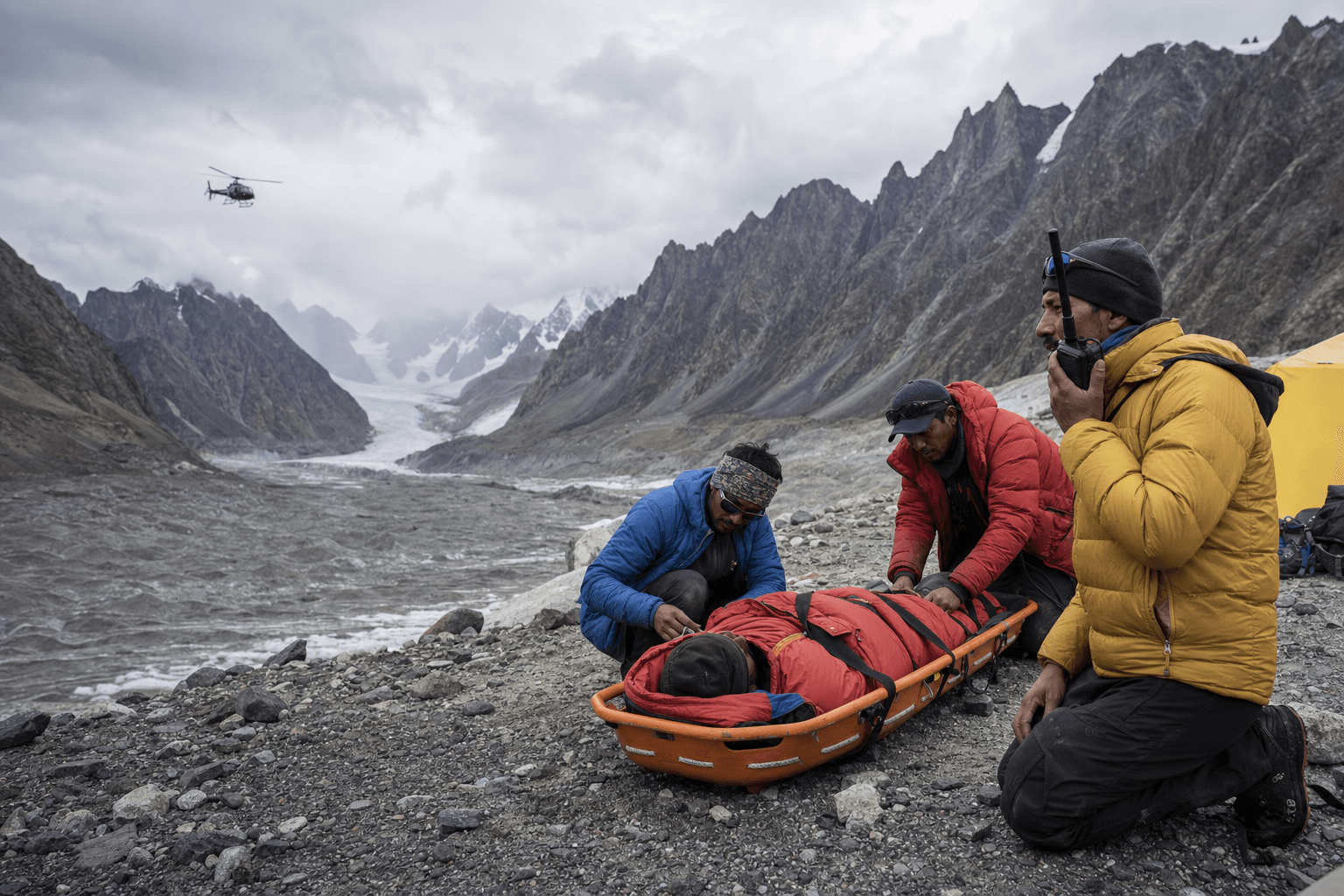
A helicopter is not an ambulance waiting beside the glacier. An evacuation requires communication, assessment, authorisation, suitable weather, aircraft availability, a workable landing or extraction site and, commonly, financial approval before launch.
The usual incident chain
• The guide assesses the casualty and gives immediate care.
• The field team reports the condition, position and urgency to the operations base.
• Operations contacts the insurer, assistance provider and relevant aviation or government channels.
• The insurer supplies the required authorisation or payment guarantee.
• The aviation provider assesses weather, daylight, altitude and landing feasibility.
• The casualty is moved to Skardu or another appropriate point when a safe flight is possible.
Cloud, wind, snow, darkness, aircraft availability, crew limitations, glacier conditions, altitude and delayed authorisation can all prevent or postpone a flight. A clear camp does not guarantee a clear route from Skardu. Our emergency planning therefore never assumes immediate helicopter access.
The team must retain the ability to give first aid, monitor the casualty, descend with staff support, prepare a landing area or coordinate ground evacuation. Report headache, poor coordination, breathlessness at rest, confusion or persistent vomiting early. Early reporting creates options; late reporting removes them.
Life on the Baltoro Glacier
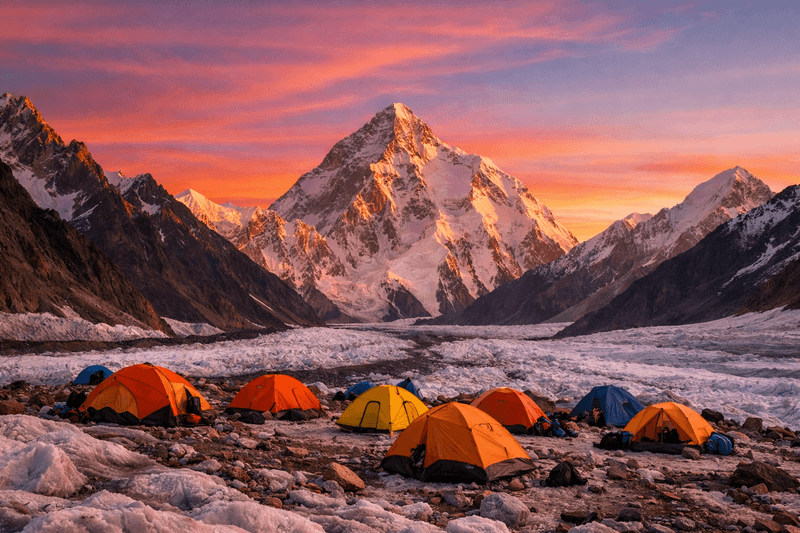
The Baltoro is not a lodge trek. After Askole, teams live in tents and move through increasingly remote camps. The challenge is usually the accumulation of early starts, uneven ground, changing temperatures, limited privacy and repeated effort at altitude.
A typical trekking day
Participants wake, pack, eat breakfast, fill water bottles and start with the guide while the crew dismantles camp and organises loads. After controlled breaks and a trail lunch, the team reaches the next camp, changes into dry layers, hydrates, rests and attends the evening briefing. Porters and staff must move and rebuild the camp, so every facility may not be ready when the first walkers arrive.
Terrain, camps and sanitation
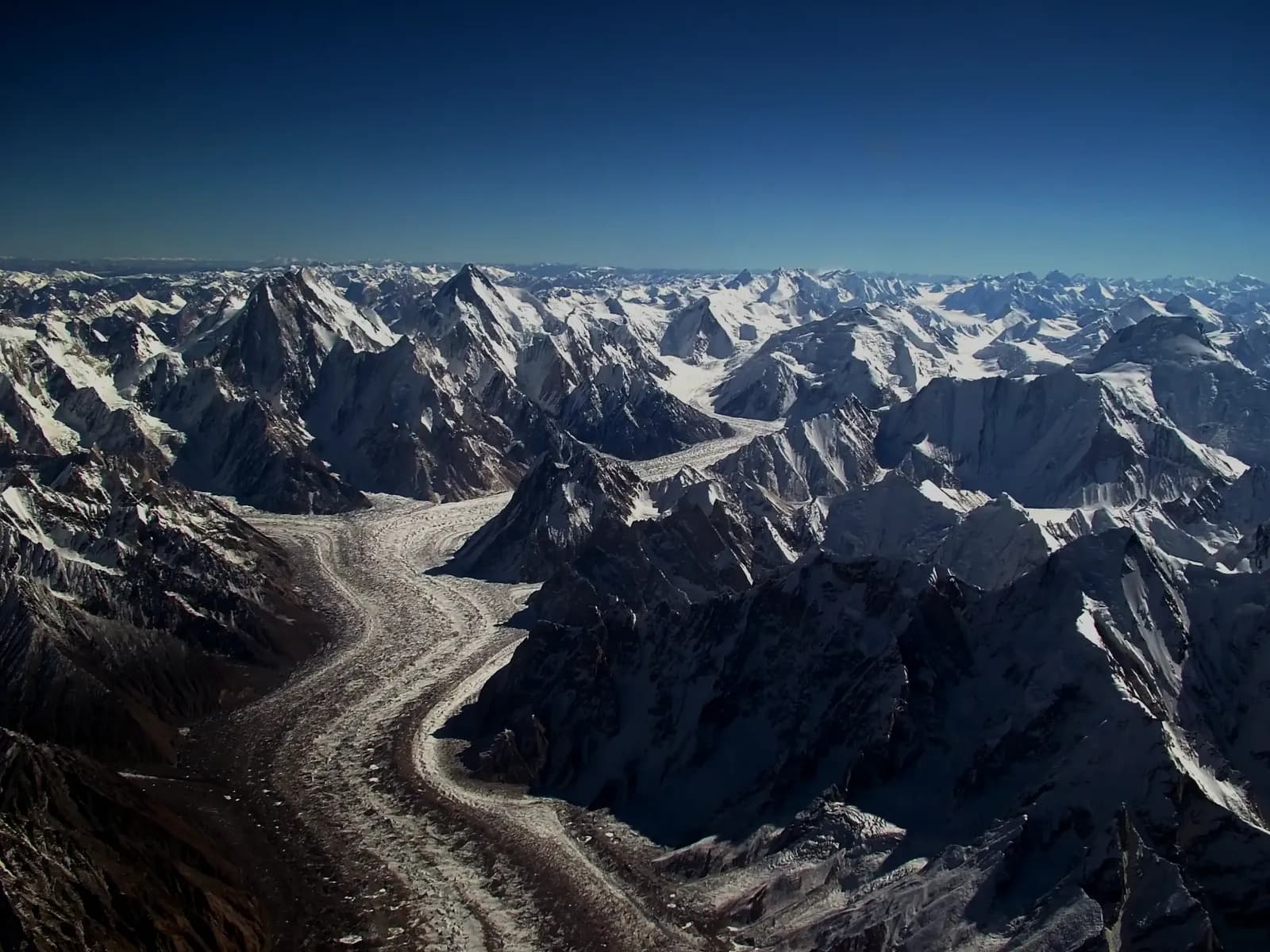
Walking on the Baltoro does not mean smooth ice. Much of the surface is moraine: loose rock, gravel, uneven ice, meltwater channels, mud and boulders. The glacier moves, and the best line changes between seasons. Walking poles and supportive, broken-in boots are valuable.
Facilities become simpler beyond Askole. Established camps may have basic toilets, but condition varies with weather, use and season. Carry hand sanitiser, toilet paper, personal hygiene supplies, foot-care items and sealable waste bags. Never leave wipes, batteries, packaging or hygiene products in a toilet pit.
Water, food and power
Glacial water contains fine sediment and may remain cloudy after treatment. Follow the team’s water routine and carry adequate bottle capacity. Keep filters and batteries from freezing. Fresh produce becomes limited farther from Askole, and appetite often falls with altitude. Eat and drink steadily. Tell us about allergies and medical dietary restrictions during booking.
Do not expect continuous mobile coverage or mains electricity. Satellite communications, radios and solar charging are operational resources. Bring power banks, reliable cables, spare batteries, offline documents and emergency contacts on paper.
Weather and recovery
Lower approach days can be hot in direct sun; upper camps can be cold, wet and windy, with snow possible during the operating season. Use a layered system with sun protection, insulation and full waterproofs. Forecasts have limited precision in the upper Karakoram.
On reaching camp, change into dry layers, drink, eat, check feet, prepare the next day’s clothing and report symptoms. Small problems are easier to manage before they become injuries.
K2 Base Camp versus Everest Base Camp
Both routes reach the foot of an 8,000-metre mountain, but their logistics are very different. K2 Base Camp uses a remote, self-contained camping expedition from Askole across long sections of moraine and glacier. The standard Nepal route to Everest Base Camp passes through settlements and normally uses teahouses and lodges.
The K2 approach has limited resupply and communication, fewer independent services and a more complex evacuation environment. The Everest route is busier and has more commercial infrastructure, though altitude, weather and mountain flights still demand respect.
Is K2 Base Camp harder?
For many experienced trekkers, K2 Base Camp is more committing because of its remoteness, rough glacier terrain, consecutive camping days and distance from road access. Everest Base Camp also involves serious altitude exposure and should not be underestimated.
K2 Base Camp and Gondogoro La are different journeys
A standard K2 Base Camp itinerary may return through the Baltoro. A Gondogoro La itinerary crosses a high pass toward Hushe and can require crampons, harness, helmet, fixed-rope movement and a night departure. Snow, avalanche exposure, rockfall, rope condition, weather or team health can force a return through the Baltoro. The crossing is never guaranteed.
Compare our standard K2 Base Camp Trek at /trekking/k2-base-camp-trek with the K2 Base Camp and Gondogoro La journey at /trekking/k2-base-camp-gondogoro-la-trek-local-guide before choosing.
Porter loads and expedition logistics
There is no road beyond Askole. Tents, food, fuel, kitchens, medical supplies and group equipment move with people and pack animals. Load planning begins in Skardu and considers route, duration, team size, resupply and emergency margin.
A personal baggage allowance is an operational limit. Extra weight changes recruitment, animal allocation, staff food, insurance records, camp movement and cost. Remove unnecessary clothing, oversized toiletries and duplicate equipment in Skardu. Keep critical medication, waterproofs, warm layers, water and sun protection in the daypack because the porter bag may arrive later. Waterproof sleeping bags, down clothing, electronics and documents inside the duffel.
Porter welfare is part of expedition safety
Porters are members of the expedition workforce, not an invisible transport system. Responsible operation includes transparent recruitment, agreed wages, load control, insurance, food, safe water, shelter, appropriate clothing and footwear, medical care, fair treatment when ill or injured and safe return arrangements.
Why one universal load figure is misleading
Limits depend on current regulation, porter category, terrain, altitude and individual condition. A low-altitude approach porter and a high-altitude climbing porter do not perform the same work. We follow the applicable official limit, weigh and record loads, divide awkward cargo sensibly and rebalance when conditions change. A legal maximum should not automatically become the target for every person or stage.
Equipment, illness and injury
Staff equipment must suit the assigned terrain and role. Issued kit must fit, function and be available before it is needed. Porters face altitude illness, gastrointestinal disease, cold injury, trauma and exhaustion. A worker who becomes ill should not be forced to continue carrying; the response must include assessment, treatment, descent, accompaniment, payment and safe return as appropriate.
Tips are separate from wages. If participants wish to give equipment or clothing, they should speak with the expedition leader so distribution remains fair. A successful expedition returns its staff safely as well as its guests.
Pre-departure checklist
Three to six months before travel
• Confirm the correct itinerary, maximum altitude and technical activity.
• Check passport validity and submit a clear copy.
• Complete the operator agreement and provide climbing résumés where required.
• Receive sponsorship documents and begin the official visa and permit process.
• Purchase insurance covering the exact route and review government travel advice.
One month before travel
• Confirm visa approval and check every passport and visa detail.
• Send final insurance documents and emergency contacts.
• Confirm dietary and medical information.
• Review the equipment list and baggage allowance.
• Carry printed and offline document copies.
Before leaving Skardu
• Complete the equipment inspection and remove surplus luggage.
• Waterproof the porter bag and retain essential items in the daypack.
• Confirm emergency communications and attend any required briefing.
• Report illness before travelling to Askole.
Final advice from our operations team
The strongest expedition plans are conservative in administration and flexible in the field. Apply early. Use the correct visa category. Treat the invitation letter, visa and permit as separate documents. Buy insurance that names the activity and altitude. Do not assume a helicopter can fly immediately. Keep baggage within the agreed allowance. Ask how staff are insured, equipped and supported.
Once the team leaves Askole, small planning errors become difficult to correct. Before departure, they are usually straightforward.
Frequently asked questions
Do I need a special visa for the K2 Base Camp trek?
Foreign participants should use the category required by the official Pakistan Online Visa System for their trekking activity. Confirm the current category with the licensed operator and portal.
Who provides the Pakistan letter of invitation?
The designated Pakistani operator normally provides it after receiving the required booking and passport information.
Can I obtain a Baltoro trekking permit myself?
Foreign teams normally complete regulated trekking and mountaineering formalities through a licensed Pakistani operator before arrival.
How long does a Pakistan trekking permit take?
Timing varies. Official guidance has advised at least 30 days for some permits; we recommend starting the full documentation process at least three months before departure.
Does K2 Base Camp require a climbing permit?
The trek requires applicable trekking permissions. Attempting K2 or another regulated peak requires a separate mountaineering permit.
What altitude must my insurance cover?
At least the maximum altitude of the booked route. K2 Base Camp is commonly listed at approximately 5,150 metres; Gondogoro La and climbing itineraries require higher or technical cover.
Is helicopter rescue guaranteed?
No. Weather, daylight, aircraft availability, authorisation, payment arrangements and safe operating conditions all affect a flight.
Will ordinary travel insurance cover K2 Base Camp?
Not necessarily. Standard policies may exclude high altitude, remote trekking, rescue or travel affected by official advisories. Obtain written confirmation.
Are there lodges on the Baltoro Glacier?
There is no continuous lodge network. Organised teams normally use tented camps after Askole.
Can Gondogoro La be guaranteed?
No. The guide may cancel the crossing because of snow, avalanche exposure, rockfall, rope condition, weather or team health.
End of field note
Continue your research.
Browse all notes