In this field note13 sections +Close −
- 01Why Snow Lake works as a ski objective
- 02The approach from Skardu and Askole
- 03Moving from moraine to ski travel
- 04Snow Lake is a place, not a single line
- 05Crevasse and avalanche management
- 06Weather and daily timing
- 07Life in a high moving camp
- 08Fitness and technical standard
- 09Equipment checklist
- 10Health, insurance and rescue
- 11Who should choose this expedition?
- 12Internal planning links
- 13Frequently asked questions
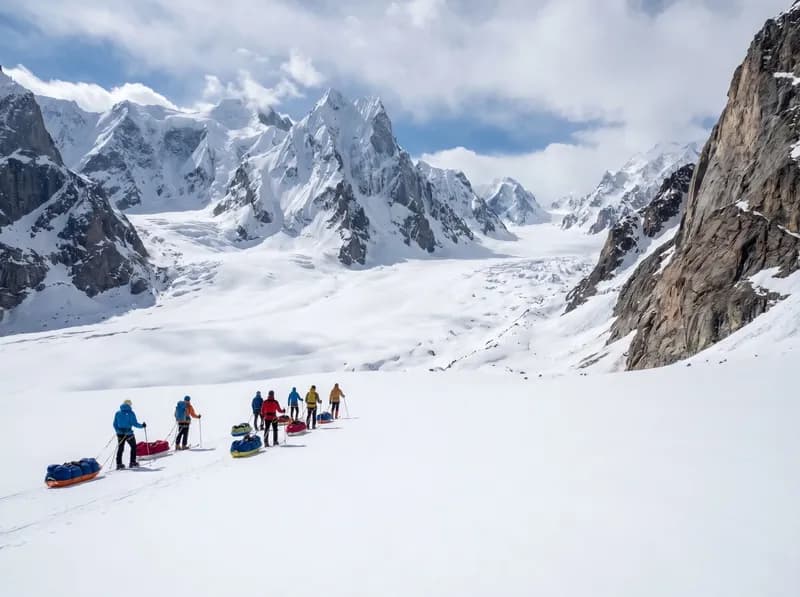
Snow Lake, known locally as Lukpe Lawo, is a broad high-altitude accumulation basin at the head of the Biafo Glacier. On a map it can look like a natural ski arena: wide snowfields, surrounding peaks and the continuation toward Hispar La. In practice, reaching it requires a serious remote expedition from Askole.
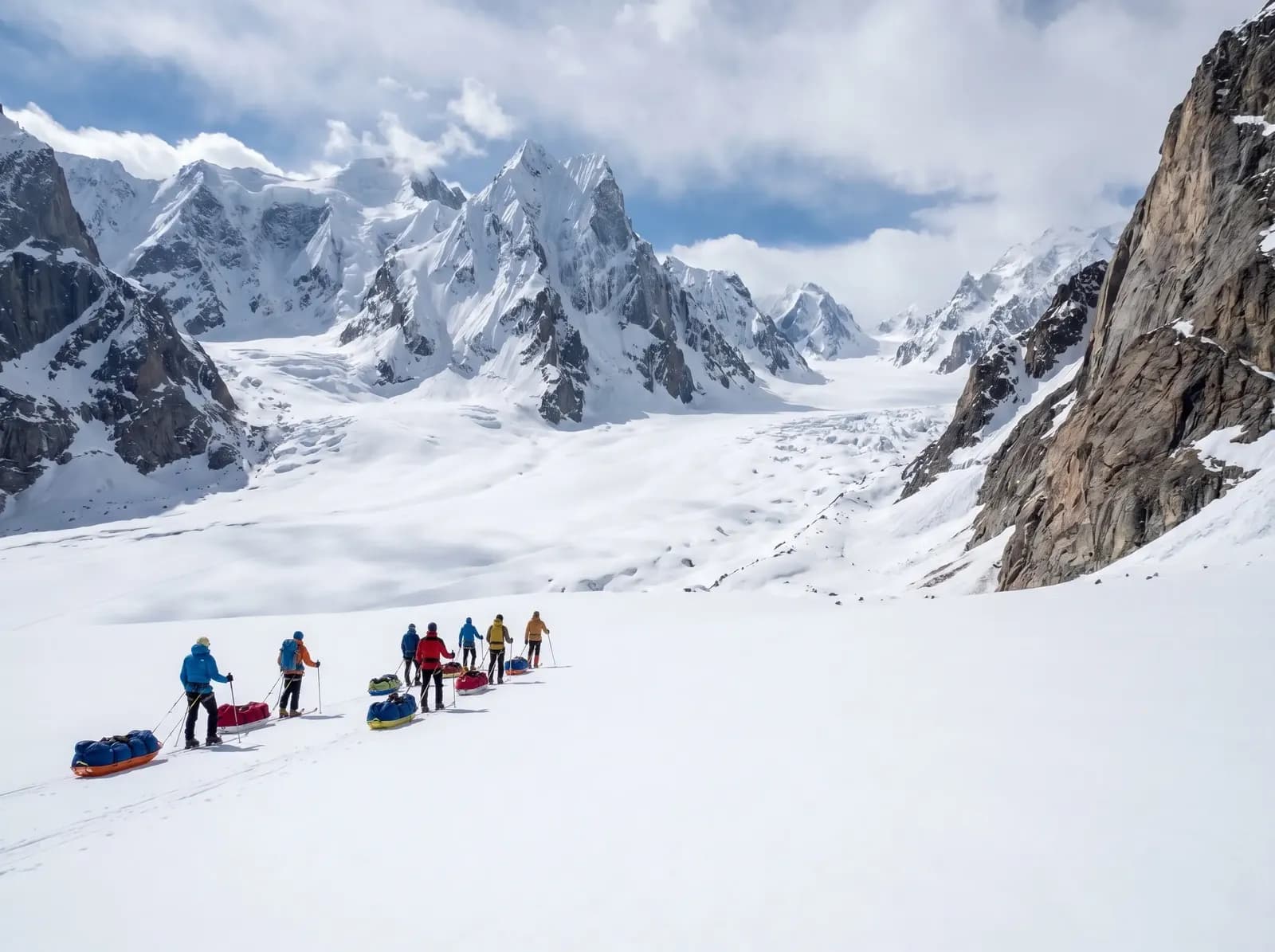
The Biafo changes character as the team climbs. Lower stages can involve rough moraine, exposed ice and broken terrain where skis are carried or moved separately. Higher up, snow cover becomes more continuous, crevasse navigation more important and skis more efficient. The journey succeeds through load management, acclimatisation and patient route finding long before the best turns begin.
Field truth: Snow Lake is not difficult because of one technical move. It is difficult because the team has to remain organised for many days while moving a complete camp into a crevassed, high and weather-exposed basin.
Why Snow Lake works as a ski objective
The upper Biafo is nourished substantially by direct snowfall and opens into the gently angled accumulation areas of Snow Lake and the Sim Gang system. Scientific field work on the Biafo Glacier’s hydrology describes these broad upper zones. Their scale is what makes ski travel attractive—and navigation demanding.
Stage | Surface and travel | Main operational issue |
|---|---|---|
Skardu to Askole | Mountain road | Weather, landslide and roadhead changes |
Askole to lower Biafo | Trail and moraine | Heat, loads and transition to glacier |
Lower to middle Biafo | Debris, exposed ice and intermittent snow | Carrying skis, camp placement and route finding |
Upper Biafo | More continuous snow and glacial travel | Crevasses, roping and altitude |
Snow Lake basin | Broad high snowfields | Visibility, wind, navigation and safe objectives |
The exact camp names and number of stages can change. Glacier surfaces, porter movement, snow line and team condition determine the practical itinerary. A fixed online schedule should be treated as an outline, not a promise that every camp will sit at the same coordinates.
The approach from Skardu and Askole
The expedition normally assembles in Islamabad and continues to Skardu by flight or road. Skardu is where we inspect equipment, buy fresh and bulk supplies, divide loads and confirm permits, insurance and communications. Missing specialist ski parts are difficult to replace locally, so this inspection must happen before departure.
The road from Skardu crosses into Shigar and follows the Braldu system toward Askole. Floods, landslides and repairs can change the last vehicle point. In Askole, porter teams and loads are finalised. It is important to keep personal weight within the allowance: every extra kilogram affects recruitment, food, insurance and the speed of the moving camp.
Early walking can be dry and warm in direct sun. Skiers sometimes underestimate this because they have packed for a snowy objective. Sun hat, light layers, water capacity and trail footwear matter before the cold equipment is used.
Moving from moraine to ski travel
On the lower glacier, the question is not “Can I force a few metres of skiing?” It is “What method moves the team and equipment most safely?” Skis may be strapped to packs, carried by the individual or assigned within a controlled load system. Transitions take time, and delicate bindings can be damaged by rough transport.
Continuous snow does not remove hazards. It hides them. Snow bridges over crevasses vary with depth, temperature and time of day. The guide sets rope spacing and decides whether skis remain on during roped travel. Every skier should be able to manage kick turns, skins, ski crampons, harness and rope without creating tangles.
Snow Lake is a place, not a single line
The basin is surrounded by potential tours and mountaineering objectives, but safe options depend on current snow, acclimatisation, weather, glacier access and the group’s technical ability. A strong team may explore higher terrain; another may use skis mainly for efficient glacier travel and moderate descents.
Hispar La is a separate commitment. Crossing toward the Hispar Glacier changes the evacuation, transport and camp plan. It should not be added casually because conditions look good for one afternoon. The full traverse requires suitable snow bridges, route knowledge and support arrangements on the far side.
Historical expedition records also remind us not to assume a line is safe because it has been travelled before. A 1997 Biafo–Hispar ski attempt reported in the Alpine Journal turned back in dangerous snow. Turning around is part of the route history, not a failure to be hidden.
Crevasse and avalanche management
Snow Lake combines glacial and avalanche problems. Wide, low-angled terrain can contain crevasses, while slopes rising from the basin may load with wind slab or release avalanches into travel corridors. Flat light can remove visual definition and make both route finding and skiing difficult.
Essential team skills
- Transceiver search, strategic shovelling and probing
- Roped glacier travel on skis and on foot
- Crevasse rescue with hauling systems
- Building snow and ice anchors
- Navigation in whiteout using map, compass and GPS
- Cold injury recognition and shelter construction
- Clear group spacing and radio communication
The guide may shorten or cancel a tour after digging observations, seeing wind transport or receiving a poor weather forecast. No summit or descent is owed to the group because it appears in a brochure.
Weather and daily timing
Spring often offers a more settled base and longer daylight for the high glacier, but it also produces strong solar effects. A firm surface can be efficient at dawn and unsupportable later. Wind may strip one aspect and load another. New snow can cover tracks and bridge clues overnight.
Daily timing balances several factors:
- Overnight freeze and snow firmness
- Avalanche exposure on approach and descent
- Crevasse visibility and bridge strength
- Distance between camps or objectives
- Team acclimatisation and load speed
- Forecast cloud, wind and temperature
There is no universal “alpine start” that solves every combination. On a moving camp day, porter and kitchen logistics also affect departure.
Life in a high moving camp
Camp is the expedition’s recovery system. Sleeping tents must be anchored for wind and placed after checking the glacier surface. The kitchen melts or treats water, manages fuel and produces food that remains appetising at altitude. Solar power and satellite communication serve operations first.
Ski boots create specific problems. Liners hold moisture, shells become rigid and buckles can ice. Keep liners warm, brush snow from equipment before entering the tent and use a repair kit designed for the binding and boot. Do not dry equipment so close to a flame that it deforms or becomes a fire hazard.
Evening routine
- Drink and eat before appetite drops.
- Change damp layers immediately.
- Inspect feet and hands for hot spots, numbness or colour change.
- Dry skins according to the guide’s camp system.
- Check binding screws, pole baskets and boot hardware.
- Prepare headlamp, harness and clothing for the morning.
- Report headache, nausea, cough or unusual fatigue.
Fitness and technical standard
A suitable participant is an efficient ski tourer, not simply a good resort skier. You should be able to climb for several hours on skins, repeat that effort on consecutive days and ski variable ungroomed snow with a pack. You also need enough strength to carry skis and personal equipment through broken lower-glacier terrain.
Training should combine aerobic base, uphill specificity, leg strength, balance and recovery. The final eight to twelve weeks should include long tours or hikes on consecutive days. Practise kick turns, transitions and crampon movement while tired but still controlled.
Technical training must precede the trip. The expedition is a poor place to learn transceiver search or crevasse rescue for the first time. A refresher immediately before departure is useful even for experienced skiers.
Equipment checklist
Ski system
- Touring skis appropriate for expedition snow and loads
- Pre-fitted skins plus repair tail clips or straps
- Ski crampons compatible with bindings
- Personally fitted touring boots and spare critical hardware
- Adjustable poles with large baskets
- Binding-specific tools and verified spare parts
Safety system
- Three-antenna transceiver, metal shovel and probe
- Harness, helmet, ice axe and boot crampons
- Prusiks, locking carabiners and assigned rescue hardware
- Headlamp with protected spare batteries
- Personal first-aid and prescribed medication
- Insurance details and emergency contacts offline
Camp system
- Cold-rated sleeping bag and insulated mat arrangement
- Waterproof duffel liners and dry bags
- Expedition down insulation and full shell clothing
- Sun and glacier eye protection with a backup pair
- High-energy snacks that remain edible when cold
Health, insurance and rescue
Fitness does not prevent acute mountain sickness. The team follows a gradual profile and monitors symptoms. Anyone with worsening headache, vomiting, poor coordination, confusion or breathlessness at rest needs prompt assessment; ascent may stop and descent may be required.
Insurance must cover Pakistan, the route’s maximum elevation, ski touring or ski mountaineering as applicable, glacier travel, search, rescue, medical evacuation and repatriation. Helicopter rescue is not guaranteed by a policy. The aircraft still needs suitable weather, daylight, availability, authorisation and a workable landing or extraction point.
Who should choose this expedition?
Choose Snow Lake if you value a remote glacial journey as much as the skiing, can live comfortably in a moving tented camp and respond well to uncertainty. It is a poor choice if your priority is lift access, guaranteed powder, daily showers or a fixed list of descents.
Before booking, discuss any weak area honestly. A shorter valley-based programme or summer Biafo journey can be a better first step and often leads to a stronger future ski expedition.
Internal planning links
See the full Snow Lake Ski Expedition, compare the summer Snow Lake and Hispar La Trek, or consider the Biafo Glacier Trek. Read next: ski expeditions in Gilgit-Baltistan, best time for a ski expedition and expedition fitness.
Frequently asked questions
Where is Snow Lake?
Snow Lake, or Lukpe Lawo, is a high glacial basin at the head of the Biafo Glacier in Pakistan’s Karakoram. It is approached from Askole through the Biafo system.
Is Snow Lake a downhill ski holiday?
No. It is a human-powered expedition involving long approaches, moving camps, glacier travel and variable snow. Skiing is integrated into a much larger journey.
Do I need crevasse-rescue experience?
Yes. Participants should arrive familiar with roped glacier travel and crevasse rescue. The guide leads the system, but team members must function safely within it.
Can the expedition cross Hispar La?
Only when the itinerary, permits, support plan, snow, weather and team are suitable. A traverse is a larger logistical commitment than visiting Snow Lake and cannot be improvised.
What is the best month for Snow Lake skiing?
There is no guaranteed month. Spring is generally the practical window for deeper high-glacier travel, but winter snow, access and current weather determine the final plan.
Is helicopter evacuation possible?
It may be possible in suitable conditions, but it is never guaranteed. Weather, altitude, landing terrain, aircraft availability and authorisation can all delay or prevent a flight.
End of field note
Continue your research.
Browse all notes